
Why Do Jaw Crusher Toggle Plates Break?
An industrial Q&A manual isolating why jaw crusher toggle plates experience premature fatigue shear, what causes tension rod rattle, and how to fix it.
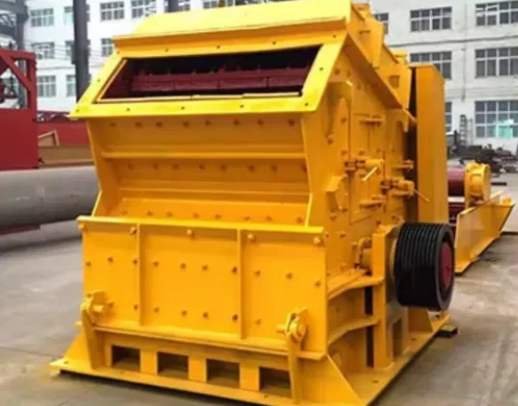
Metrological Overview & Safety Protection Physics
In heavy-duty primary mineral reduction and aggregate processing circuits, the jaw crusher acts as the initial high-impact compression node. Operating under intense cyclical loading profiles, the machine crushes raw rock blocks via a moving jaw pitman propelled by an eccentric shaft gear drive.
Because the raw quarry feed pool routinely encounters uncrushable foreign objects, the mechanical system requires a built-in structural weak point to act as a physical overload "fuse." This critical role is performed exclusively by the toggle plate (typically a sacrificial cast-iron or carbon steel beam supporting the lower base of the pitman).
When a toggle plate shears, it is performing its mechanical safety duty. However, when toggle plates suffer premature fatigue cracking or frequent unexplained failures, it indicates deep underlying structural misalignments, improper torque settings, or severe component wear.
This technical Q&A diagnostic manual breaks down the precise physics, torque tolerances, and alignment steps required to isolate and rectify jaw crusher toggle plate failures.
Technical Q&A Diagnostic Manual
Q1: What is the mechanical engineering function of a jaw crusher toggle plate?
A1: The toggle plate serves two primary structural purposes within a single-toggle jaw crusher layout:
- Kinetic Transmission Link: It acts as the lower pivot stabilizer, guiding the exact elliptical crushing stroke trajectory of the moving jaw pitman as it compresses raw rock material against the fixed jaw plate.
- Sacrificial Overload Protection (Mechanical Fuse): It is calculated and cast to a precise structural loading threshold. If an uncrushable object (such as a hard manganese excavator bucket tooth or large steel tramp iron debris) enters the crushing cavity, the crushing force exceeds the yield strength of the toggle plate. The plate instantly snaps (shears) in half, allowing the lower pitman to swing free and protecting the multi-thousand-dollar eccentric shaft, main bearings, and structural steel main frame from catastrophic torque destruction.
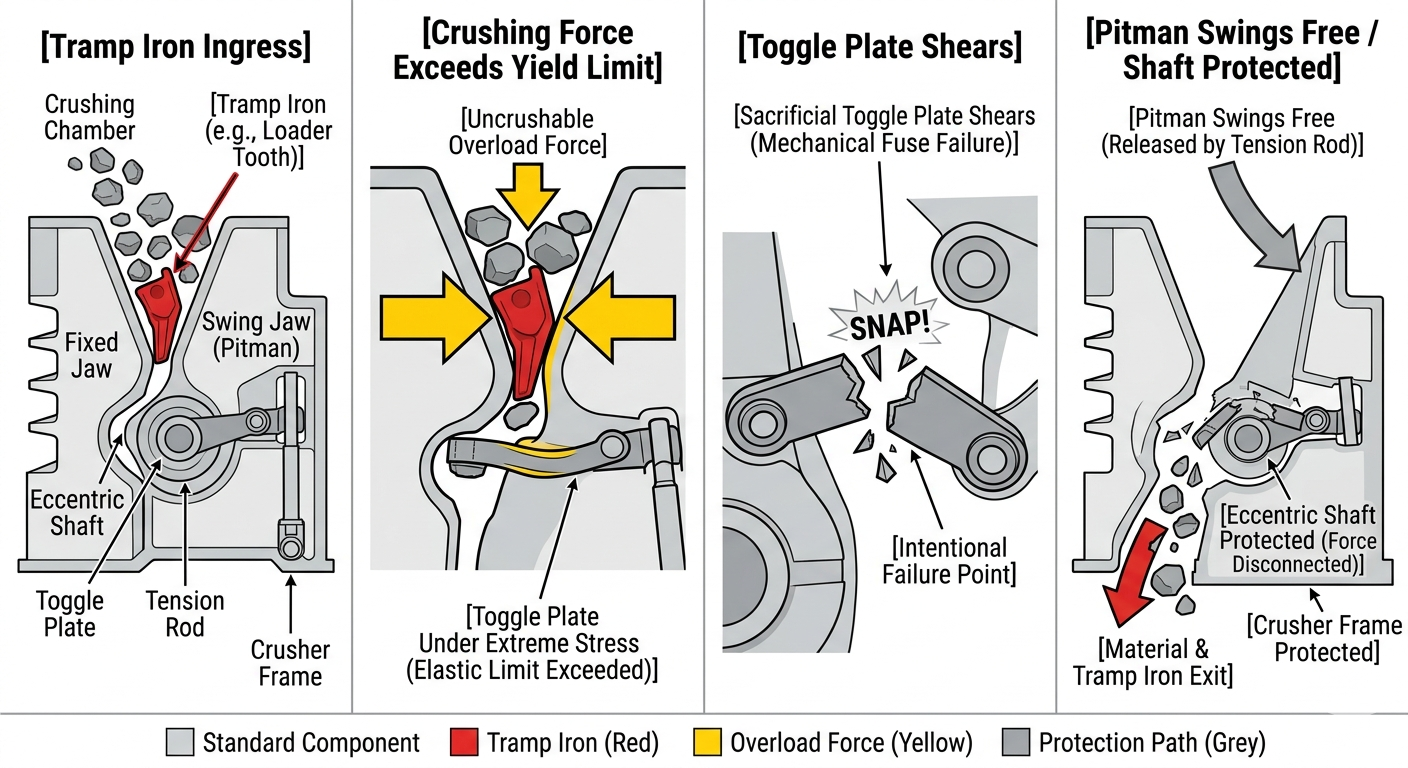
Q2: Why does a jaw crusher toggle plate break prematurely under standard aggregate loads?
A2: When a toggle plate breaks without the presence of uncrushable tramp iron, the root cause is typically traced to chronic tracking and mechanical wear variables:
- Toggle Seat Misalignment and Curved Wear: Over multi-shift operations, fine stone dust migrates into the toggle seat pockets. If lubrication film breakdown occurs, the friction coefficient shifts from a rolling action to a grinding action. This wears an asymmetric groove into the toggle seat, creating severe localized stress concentrations that trigger fatigue cracks along the center line of the toggle plate.
- Tension Rod Spring Relaxation: The moving jaw is held tight against the toggle seats via a heavy-duty tension rod compression spring. If the maintenance crew allows the tension rod spring nuts to relax (or if the spring suffers material fatigue), the toggle plate will lose its continuous compressive preload. During the back-stroke cycle, the toggle plate will violently rattle and slam inside its seats, causing immediate mechanical impact fracturing.
- Improper Closed-Side Setting (CSS) Scaling: Forcing a jaw crusher to operate with an aggressively tight CSS that breaches the factory's minimum parameters causes severe material compaction (packing). The aggregate cannot escape fast enough, generating immense backpressure forces that overpower the toggle plate's standard nominal limits.
Q3: How do you measure and troubleshoot toggle seat parallelism errors?
A3: If your new replacement toggle plates are shearing within less than 200 operating hours, the structural seats have drifted out of geometric parallelism. To troubleshoot this:
- Isolate the machinery using strict Lockout-Tagout (LOTO) protocols and completely extract the broken toggle components.
- Thoroughly clean the upper pitman toggle groove and the lower rear wedge block toggle pocket using industrial solvents and wire brushes.
- Mount a high-precision magnetic base dial indicator onto the rear structural frame wall.
- Measure the center-to-center horizontal alignment distances across both the left and right sides of the toggle seats. The maximum allowable parallelism deviation across a standard 1200mm wide jaw crusher block must not exceed ±0.5 mm.
- If the deviation exceeds this boundary, the rear adjust wedge blocks must be unbolted and re-shimmed using precision high-tensile steel shims to return the seat pockets to a perfect 90-degree perpendicular axis relative to the pitman center line.
Technical Specifications & Torque Matrix
The metrological specification matrix below outlines the strict physical parameters and mechanical limits required to maintain optimal jaw crusher toggle configurations.
| Operational Parameter / Siting Node | Target Engineering Boundary | Emergency Failure / Fault Threshold | Specialized Measurement Device |
|---|---|---|---|
| Toggle Seat Parallelism Tolerance | ≤ 0.5 mm Total Indicator Reading | > 2.0 mm (Severe Stress Focus) | Dial Test Indicator & Laser Align |
| Tension Rod Spring Compression | Factory Specified (e.g., 140 mm) | Spring Fully Bottomed Out / Loose | High-Precision Vernier Calipers |
| Toggle Seat Back-Clearance Spacing | 0.0 mm (Continuous Preload Lock) | > 3.0 mm (Vibration Impact Slam) | Carbon Feeler Gauge Strips |
| Flywheel Shaft Runout Limit | ≤ 0.08 mm Max | > 0.25 mm (Bearing Fatigue) | Magnetic Base Dial Gauge |
| Toggle Pocket Dust Seal Clearance | Completely Sealed IP54 Equivalent | Torn Boot (Rapid Dust Ingress) | Physical Visual Inspection |
How to safely execute a toggle plate replacement sequence
When a toggle plate snaps mid-shift, maintenance crews must execute this highly structured, safety-compliant extraction and reconstruction sequence:
- Step 1: Complete Cavity Evacuation and Fluid Power Isolation: Shut down the main electric drive motor. Verify that the crushing cavity is 100% empty of rock. If the plate sheared mid-crush, manually hook and hoist all trapped boulders out of the chamber. Lock out the main electrical grid panel.
- Step 2: Compress the Tension Rod Spring Array: Locate the rear tension rod assembly at the lower base of the crusher. Use a heavy-duty impact wrench to tighten the tension nut, compressing the heavy coil spring. This draws the tension rod forward, releasing the mechanical clamping force holding the moving jaw pitman against the rear framework.
- Step 3: Secure the Pitman via Crane Hoist: Attach a certified overhead crane or a heavy mobile excavator hook to the lifter eyes engineered on the moving jaw pitman. Gently winch forward to pull the lower section of the heavy pitman away from the rear adjustment wedge block, creating a clean 150 mm structural clearance opening in the toggle zone.
- Step 4: Extract Debris and Align New Toggle Components: Remove the fractured steel segments of the old plate. Thoroughly scrape out the grease beds inside the upper and lower toggle seats. Inspect the seats for cracks; if they show pitting, swap them out for new high-bronze or manganese-alloy seat pads. Place a fresh, OEM-certified toggle plate into the lower seat bed, ensuring the radiused edges seat perfectly flush.
- Step 5: Release Tension and Calibrate Spring Preload: Slowly slacken the crane winch, allowing the heavy pitman to drift back until its upper groove nests firmly onto the top edge of the new toggle plate. Back off the tension rod spring nuts until the spring expands back to its precise factory working dimension (e.g., 140mm compressed length). This locks the entire toggle alignment under thousands of Newtons of continuous spring pre-load force, eliminating back-stroke vibration slam.
FAQ
Q1: What metallurgic criteria should a procurement director mandate when sourcing replacement toggle plates for high-silica iron ore applications?
A1: Sourcing directors must strictly avoid cheap, unbranded scrap-metal castings. For high-abrasion, high-impact mining applications (like processing granite, quartzite, or iron ore), replacement toggle plates must be specified as High-Strength Gray Cast Iron (HT250 or HT300 specifications) or highly specialized low-carbon ductile iron. Gray iron features excellent internal compressive strength while maintaining a highly uniform, brittle crystal fracture matrix. This metallurgic consistency ensures the plate will snap cleanly and instantenously at its calibrated shear threshold during an emergency tramp iron event, rather than bending elastically like cheap ductile scrap, which delays safety actuation and destroys main shaft bearings.
Q2: Why should a quarry purchasing manager source toggle seats outfitted with integrated polyurethane dust-boot enclosures?
A2: Fine aggregate stone dust is highly abrasive. If allowed to mix with the toggle pocket grease, it creates a grinding paste that destroys toggle seat tolerances within weeks. Mandating heavy-duty, flexible polyurethane dust-boot enclosures that wrap completely around the toggle joint completely seals out environmental airborne particles. This simple component upgrade extends the operational life of your toggle plates and high-bronze seats by up to 300%, slashing ongoing maintenance OPEX and eliminating frequent tracking adjustments.
TAG
Jaw Crusher Toggle Plate, Jaw Crusher, Toggle Plate Failure, Toggle Plate Replacement, Toggle Plate Function, Jaw Crusher Maintenance, Jaw Crusher Troubleshooting, Toggle Seat Alignment, Tramp Iron Protection, Jaw Crusher Parts, Pitman Assembly, Eccentric Shaft, Flywheel Runout, Crusher Safety System, Mechanical Fuse, Crusher Wear Parts, Aggregate Processing Equipment, Mining Crusher Maintenance, Stone Crusher Parts, Quarry Equipment Maintenance
Request Technical Blueprints & Factory Quotes
Submit your machinery parameters below. Connect directly with verified, certified heavy industrial manufacturers to receive custom foundation drawings, layout schematics, and direct-from-factory pricing.