
Twin-Shaft Concrete Mixer Discharge Gate Hydraulic System Troubleshooting & Engineering Guide
This guide helps industrial plant engineers and operators diagnose, troubleshoot, and maintain the hydraulic system controlling the discharge gate of twin-shaft concrete mixers. Correct hydraulic operation ensures consistent discharge rates, reduces wear, and prevents unscheduled downtime.
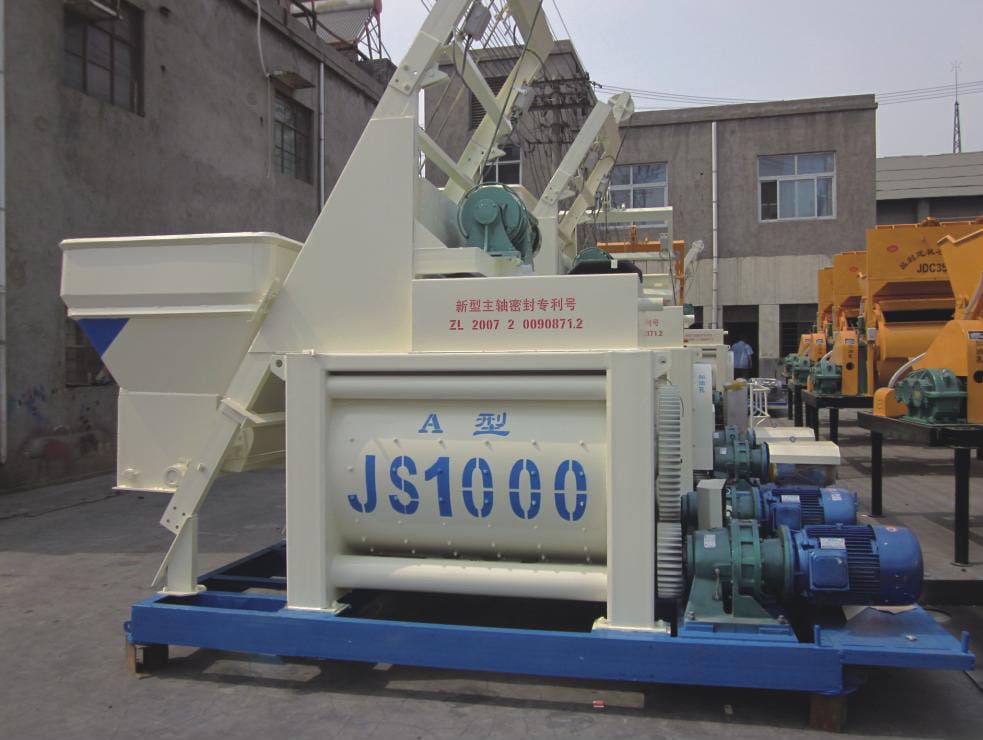
📌 Technical Overview & Core Standards
- Target Subsystem: Twin-Shaft Concrete Mixer Hydraulic Discharge Gate Assembly.
- Regulatory Compliance: Designed in accordance with ISO 4413:2010 (Hydraulic fluid power — General rules and safety requirements for systems and their components) and ISO 12100:2010 (Safety of machinery).
- Target Fluid Cleanliness: Maintained to ISO 4406:2021 Class 19/17/14 absolute particle count parameters.
- Safety Status: ⚠️ CRITICAL YMYL NOTICE (ISO 4413 §5.2.2.2): Turn off the HPU motor and completely isolate the electrical circuit via Lockout/Tagout (LOTO) protocols. You must mechanically block the gate using steel drift pins and physically vent residual accumulator gas charge before opening any hydraulic connections.
1. Quick-Reference Symptom Diagnostic Matrix
| Observed Failure Mode | Potential Root Cause | Diagnostic Metric / Sensor Reading | ISO 4413 Corrective Action |
|---|---|---|---|
| Discharge gate drifts open / slow closure | Internal cylinder piston seal bypass or directional spool wear. | Pressure gauge differential between ports A and B drops to < 1.5 MPa under load. | Re-seal cylinder bore; inspect directional spool tolerances for clearance scuffing. |
| HPU pump whining / loud cavitation | Fluid aeration, suction strainer restriction, or micro-particle scoring. | Fluid surface foaming in reservoir; pump inlet vacuum exceeds 0.03 MPa (0.3 bar). | Clean suction screen; check pump shaft lip seals; top up fluid to maximum sight glass level. |
| Gate halts midway / fails to seal completely | Aggregate mechanical jamming or pressure relief valve drift. | System line pressure caps out at < 12 MPa (Design baseline target is 16–18 MPa). | Clear aggregate debris; calibrate main relief valve screw clockwise to rated design spec. |
| Solenoid spool fails to shift cycles | Micron-level silt lockout or inductive coil thermal burnout. | 24VDC/220VAC coil draws nominal current but manual override pin remains physically seized. | Flush valve assembly with solvent; replace filter element to restore ISO 4406 limits. |
2. Step-by-Step Engineering Diagnostic Manual
Phase 1: Pre-Test Visual Inspection and Fluid Auditing
- Check Fluid Cleanliness (ISO 4406): Extract a 100ml oil sample from the mid-reservoir zone. If water contamination exceeds 0.05% (cloudy appearance) or particle counts exceed Class 19/17/14, dump and flush the loop.
- Inspect External Fatigue: Check high-pressure hoses for outer jacket blistering or wire-braid exposure. Immediately replace hoses exceeding 5 years of service life from the stamped manufacture date.
- Verify Gate Clearance: Confirm that the structural gap clearance between the mixing shell wall and the arc door radius remains between 3 mm and 5 mm.
Phase 2: System Line Pressure Diagnostics
- Install ISO-Compliant Pressure Gauges: Mount calibrated 0–25 MPa glycerine-filled pressure gauges to the system's test ports via micro-bore test hoses.
- Execute Dead-Head Relief Test: Command the discharge gate to the fully closed position. Keep the valve energized for 3 seconds:
- Pass Condition: Pressure reads exactly at the manufacturer specification (typically 16 MPa / 160 bar).
- Fail Condition: Pressure struggles to cross 10 MPa, indicating relief valve spring fatigue or structural internal pump wear.
- Run Cylinder Internal Leakage Test: Cycle the gate fully open. Disconnect the return line hose from the rod end port and plug the open hose. Apply full system pressure to the blind end port:
- Continuous oil streaming from the open rod end port confirms a blown internal piston seal.
3. Materials Science & Tribology Considerations
- Piston Rod Surface Modification: Standard raw chrome plating degrades rapidly when exposed to abrasive concrete slurry ($\text{SiO}_2$). Specify double-layer micro-crack hard chrome plating with a minimum thickness of 50 micrometers and a surface hardness exceeding 850 HV.
- Seal Formulation Requirements: Linear rod seals must be composed of high-grade Polyurethane (PU) with a minimum durometer hardness rating of Shore 95A to resist abrasive extrusion and particulate embedding.
4. Preventive Maintenance Schedules (PM Protocol)
Daily PM Checklist
- [ ] Verify HPU reservoir fluid level rests at the upper 3/4 mark of the sight glass.
- [ ] Wipe down exposed cylinder rods and verify that the rubber scraper/wiper ring is intact.
- [ ] Check all proximity switch sensor faces for concrete splatter or magnetic iron filings.
Weekly PM Checklist
- [ ] Clear structural concrete scale and crust buildup from the outer discharge gate frame rails.
- [ ] Inspect high-pressure hose routings to ensure bending radii comply with minimum bend dimensions.
- [ ] Run one manual gate cycle to check for mechanical binding or erratic stick-slip motion.
Monthly PM Checklist
- [ ] Replace HPU pressure filter elements (targeting an absolute beta rating of $\beta_{10(c)} \ge 200$).
- [ ] Gauge accumulator pre-charge pressure (ensure it maintains 60% of system operating pressure).
- [ ] Measure hydraulic fluid operational temperature; confirm it stabilizes under the 60°C maximum limit.
5. Frequently Asked Questions (FAQ)
Q1: Why does the discharge gate drift open during a mixing cycle even though the directional valve is centered?
A: Gate drift during a high-load mixing cycle is caused by a loss of hydraulic lock. This stems either from internal piston seal bypass leakage inside the cylinder or spool-to-bore clearance wear within the directional control valve. When mixing concrete, the dead weight pushes against the gate; if the fluid can sneak past the cylinder piston or the valve spool, the gate will slowly slide open.
Q2: What causes the hydraulic pump to make a loud, high-pitched whining noise when the gate opens?
A: A high-pitched whine signals pump cavitation or fluid aeration. This occurs when the pump is starved of oil due to a clogged suction strainer, a low fluid level in the reservoir, or a restricted suction line hose. It can also happen if a worn pump shaft seal is drawing air directly into the hydraulic fluid stream.
Q3: How often should hydraulic filters be changed on a twin-shaft concrete mixer?
A: Under standard operating conditions, return and pressure filter elements must be replaced every 500 operating hours or monthly. In highly dusty batch plant environments, change elements immediately whenever the differential pressure indicator pops or fluid analysis reveals contamination exceeding ISO 4406 Class 19/17/14.
Q4: What happens if the hydraulic fluid operating temperature rises above 60°C?
A: Operating above 60°C accelerates hydraulic fluid oxidation and rapidly degrades elastomer seals. High heat reduces the oil's kinematic viscosity, which increases internal component wear, causes sluggish gate movements, and results in premature cylinder and valve seal failures.
Q5: How do I safely check the pre-charge pressure of the system accumulator?
A: To safely check pre-charge pressure, shut off the mixer, isolate electrical power via LOTO, and completely discharge all hydraulic pressure using the manual bleed valve. Connect a dedicated gas charging manifold gauge to the accumulator's gas valve to read the remaining nitrogen pressure. Never fill or pressurize an accumulator with oxygen or compressed shop air—use pure Nitrogen ($\text{N}_2$) gas only.
🏷️ High-Value Industrial Keywords
- Twin-shaft concrete mixer troubleshooting
- Mixer discharge gate hydraulic system
- ISO 4413 hydraulic system compliance
- Hydraulic cylinder internal bypass leakage
- Concrete batch plant maintenance checklists
- Hydraulic pump cavitation diagnostics
- ISO 4406 fluid contamination codes
- Concrete mixer gate alignment procedures
Request Technical Blueprints & Factory Quotes
Submit your machinery parameters below. Connect directly with verified, certified heavy industrial manufacturers to receive custom foundation drawings, layout schematics, and direct-from-factory pricing.