
Mobile vs Stationary Concrete Plant: Budget & Civil Foundation Comparison
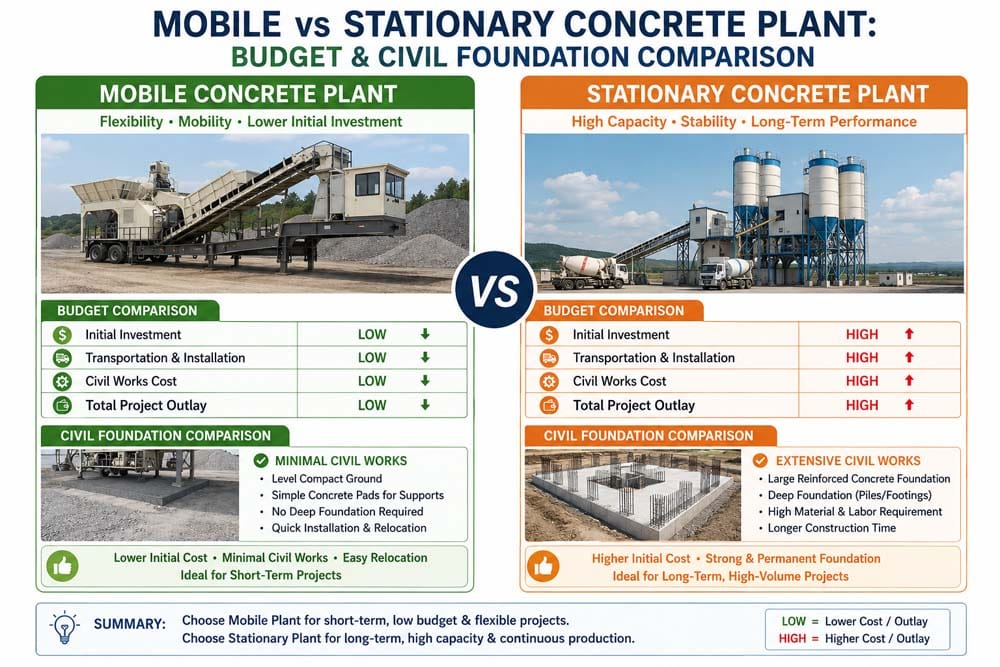
Strategic Engineering Sourcing Overview
When engineering the layout for a new construction infrastructure project, commercial ready-mix hub, or remote mining site, procurement directors face a critical capital layout decision: selecting between a Mobile (Trailerized/Compact) Concrete Batching Plant and a Stationary Heavy-Duty Concrete Batching Line.
Miscalculating the operational trade-offs between these two system architectures often leads to catastrophic financial bottlenecks. Investors frequently look only at the machinery sticker price, entirely overlooking the massive underground civil engineering foundation outlays, terminal demolition overhead, and cross-border logistical mobilization parameters.
This independent engineering assessment delivers a granular, data-driven financial and structural cross-comparison of mobile versus stationary plant configurations (specifically focusing on mainstream 50 m³/h to 120 m³/h configurations). It isolates exact budget variables, soil-bearing kPa metrics, and civil footprint requirements to help project managers protect initial capital expenditure (CAPEX) models.
Civil Engineering & Foundation Infrastructure Comparison
The primary engineering divergence between mobile and stationary plant configurations lies beneath the surface—specifically in the subsurface steel-grid reinforcement mesh and soil bearing capacity requirements.
1. Stationary Plant Foundation Dynamics (The Heavy Anchor Model)
Stationary plants—such as standard HZS60 or HZS120 lines—transfer immense, concentrated vertical dead loads and erratic dynamic cutting forces into the earth.
- Soil Bearing Constraints: Stationary systems require a highly stable, uniform soil bearing capacity not falling below 180 kPa to 240 kPa. If the structural siting falls near soft riverbeds or coastal zones, deep concrete pile driving is mandatory.
- Deep-Pit Skip Hoist Construction: Standard stationary lines utilizing bucket skip hoists demand a massive, reinforced underground concrete pit to allow the collection bucket to drop below the aggregate batcher level. This introduces complex subsurface waterproofing risks and drainage engineering costs.
- Civil Footprint Curing: The main tower columns and heavy 100-ton to 300-ton bolted cement silos require heavy-duty independent concrete footing pads utilizing C30/C35 structural concrete grades with a mandatory 21 to 28-day hydration curing window before structural machinery installation can begin.
2. Mobile Plant Foundation Dynamics (The Foundationless Chassis Model)
Mobile configurations—such as the YHZS or Quick Master series—rely on a fully consolidated, low-profile trailer chassis that distributes loading stresses horizontally over a wider footprint.
- Minimalist Civil Requirements: Mobile plants eliminate the need for underground skip-hoist pits or massive independent column anchor blocks. The structural frame can be safely deployed on a flat, uniform C25 grade horizontal concrete slab with a thickness profile of just 200 mm to 350 mm.
- Zero-Footprint Steel Outriggers: The dynamic mixing forces are absorbed by heavy-duty, integrated mechanical or hydraulic steel outriggers. This engineering configuration drops site preparation civil costs by up to 80% and completely bypasses the long structural curing timelines, allowing rapid staging on temporary or leased job sites.
Technical Specifications & Civil Engineering Matrix
The comparative data matrix below maps the strict physical boundaries, soil tolerances, and setup timelines separating mobile and stationary concrete mixing systems.
| Structural & Civil Parameter | Mobile / Compact Batching Plant | Stationary Compulsory Plant |
|---|---|---|
| Nominal Throughput Range | 25 m³/h to 100 m³/h max limits | 50 m³/h to 240 m³/h+ (Infinite Scaling) |
| Minimum Soil Bearing Capacity | 120 kPa to 150 kPa (Standard Flat Base) | 180 kPa to 250 kPa (Heavy Anchor Footings) |
| Foundation Excavation Profile | Flat Horizontal Slab (No Underground Pits) | Deep Skip Pits & Heavy Subsurface Columns |
| Structural Concrete Grade | C25 Grade Baseline Placement | C30 to C40 High-Strength Reinforced |
| On-Site Installation Window | 48 to 72 Hours (Pin-Connected Setup) | 21 to 35 Days (Heavy Cranes & Curing) |
| Silo Structural Sourcing | Horizontal Bolted / Mobile Low-Profile | Vertical Bolted (50T to 300T Matrix) |
| Relocation Salvage Metric | 95% Salvage (Zero structural concrete lost) | 40% Loss (Foundation concrete abandoned) |
Fiscal Budget Modeling & Lifecycle CAPEX Variance
To map out a true 5-year operational runway, your procurement team's financial spreadsheet must calculate localized logistical overhead and terminal asset degradation alongside the machinery cost.
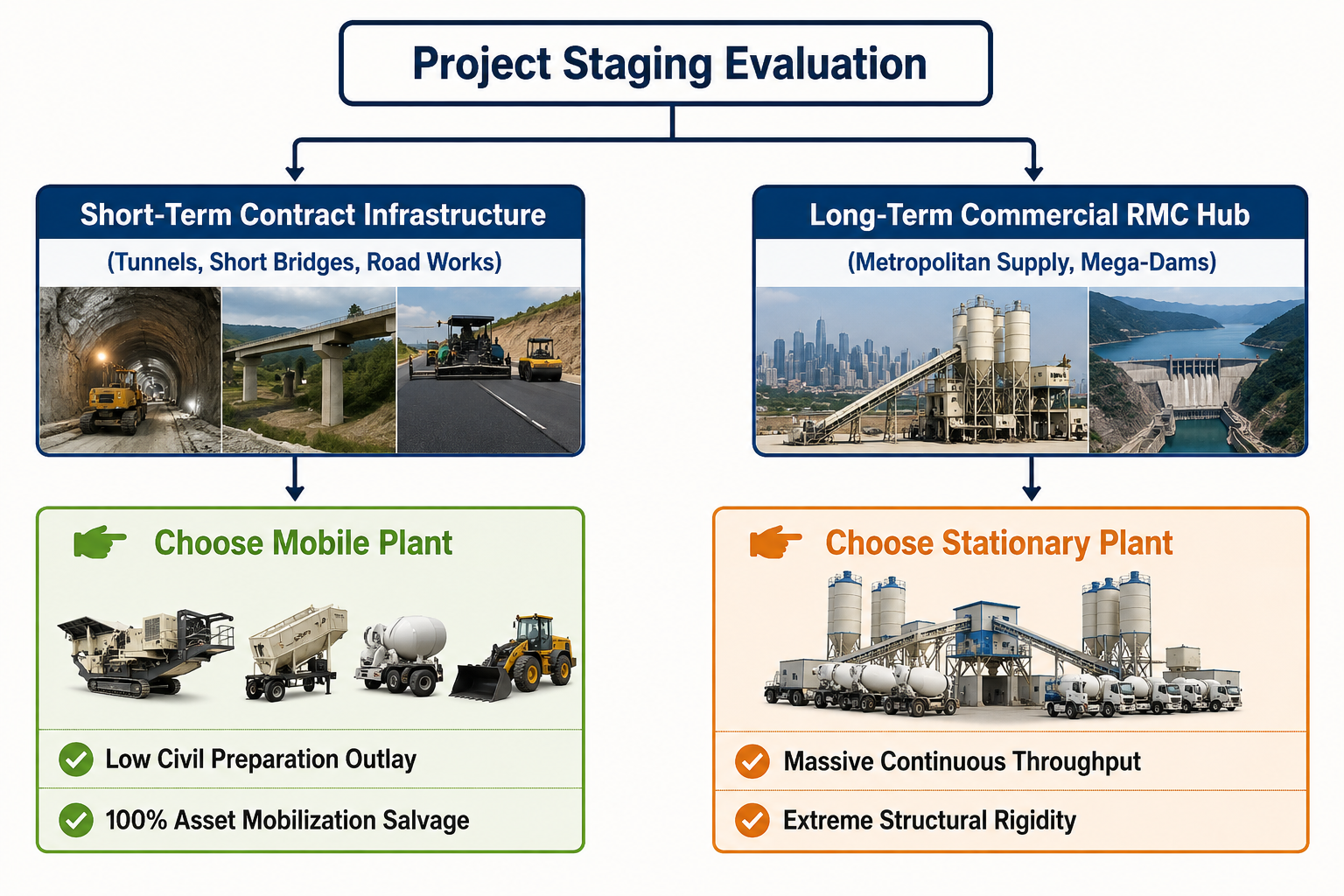
1. The Mobile Plant Sourcing Budget Profiling
- The Sourcing Advantages (Pros): Initial machinery cost is highly optimized for short runways. Ocean freight is drastically lower because the main trailer chassis features its own trailing axles and can be towed directly away from the gateway port. Most importantly, terminal demolition costs are near zero. When the construction project terminates, the pins are pulled, the outriggers retract, and the entire asset is driven to the next staging site with 0% of your civil foundation investment left rotted in the ground.
- The Trade-Offs (Cons): You pay a slight machinery engineering premium per cubic meter of output. Aggregate bin capacities are physically restricted by road-transit width regulations, requiring non-stop loading cycles via wheel loaders during heavy pours.
2. The Stationary Plant Sourcing Budget Profiling
- The Sourcing Advantages (Pros): Delivers the lowest possible operational expense (OPEX) per cubic meter over ultra-long runs (exceeding 36 months). The extreme structural rigidity of the carbon steel framework isolates mixing vibrations completely, reducing component wear and maintaining a highly stable weighing loop environment. It allows the integration of massive aggregate storage bins, reducing loader fuel costs.
- The Trade-Offs (Cons): High initial civil engineering and local construction cash burn. You must allocate a massive, non-recoverable budget for site preparation, deep excavation, and concrete pouring. When a stationary site closes, 100% of the foundation concrete must be abandoned and structurally jackhammered, resulting in a 15% to 25% dead-loss write-off of your initial infrastructure capital.
Final Procurement Sourcing Allocation Guidelines
When engineering your project parameters inside your corporate sourcing sheets, execute your final system allocation based on this strict structural checklist:
- The Timeline Allocation Rule: If your local site contract demands live, certified ready-mix concrete delivery within 15 days of port cargo clearance, mandate a Mobile Trailerized Plant. Attempting to build an HZS120 stationary grid under this timeline will cause severe contractual penalty traps due to concrete pad curing lags.
- The Volume Allocation Rule: If your total projected contract production volume across a single continuous site deployment stays below 150,000 cubic meters, a Mobile Compact Unit is the fiscal winner. If your projected structural output exceeds 300,000 cubic meters, source a Stationary Inclined-Belt Plant to completely bypass the rope-wear and hoist limits of compact mobile skip systems.
- The Environmental Fleet Siting: For urban ready-mix facilities subjected to severe localized dust and noise emission laws, choose a Stationary Tower Layout. Stationary configurations allow full eco-friendly sheet cladding and centralized baghouse dust collection encapsulation, which cannot be structurally engineered onto a moving mobile trailer chassis.
When choosing between a mobile and stationary concrete plant, the decision comes down to upfront cost flexibility versus long-term fixed volume efficiency. Mobile concrete plants have much lower foundation requirements and offer dynamic site-to-site savings. Stationary concrete plants demand high civil engineering and infrastructure investments but achieve superior fixed economies of scale.
Budget and Financial Comparison
- Initial Equipment Cost: Small mobile plants can start as low as $12,000 for mini units, but commercial-grade self-contained mobile plants typically range between $350,000 to $2,000,000. Standard stationary plants generally cost between $200,000 and $1,000,000, with massive industrial configurations running well into multiple millions. [2, 7, 8]
- Setup & Erection Costs: Stationary plants require extensive heavy cranes, specialized labor, and 3 to 6 weeks of construction time. Mobile plants are often pre-wired and modular; self-erecting designs can fully deploy in under 3 days without external crane rentals.
- Utilization & ROI: According to industry analysis by the AIMIX Group, mobile units frequently hit utilization rates exceeding 70% by moving to active jobs, compared to roughly 50% for stationary units tied to regional markets. This drastically reduces the capital cost calculated per cubic meter of concrete.
- Transportation & Logistics: Stationary plants require heavy shipping and fleet logistics to move. Mobile plants sit on integrated trailer chassis with wheels, eliminating long-distance hauling and regional concrete delivery fees.
Foundation and Civil Engineering Comparison
Foundation design is the largest hidden cost variable separating these two plant types.
| Feature | Mobile Concrete Plant | Stationary Concrete Plant |
|---|---|---|
| Foundation Requirement | Minimal to none; requires only a flat, compacted surface or light steel plates. | Heavy, permanent concrete foundation blocks and deep civil engineering works. |
| Site Prep Complexity | Low; can be set up directly on stable ground or unpaved job sites. | High; requires soil testing, deep excavation, and concrete pouring. |
| Component Support | Compact, built-in structural framework spreads weight horizontally. | Requires deep structural footings for large vertical cement silos and long conveyor belts. |
| Decommissioning Cost | Zero; just unbolt the legs, hook to a truck, and pull away. | High; involves tearing down massive structures and abandoning or breaking up concrete foundations. |
Summary Verdict
- Choose a Mobile Plant if you handle linear infrastructure like highways and tunnels, operate in remote regions, or have short-term projects spanning less than 1–2 years.
- Choose a Stationary Plant if you are establishing a commercial ready-mix business, supplying a permanent precast yard, or running a massive centralized infrastructure site (like a dam or port) for several years.
If you would like to map out the exact financials for your project, tell me:
- What is your estimated total concrete volume (m³)?
- What is the duration of the project?
- Is the project located in one fixed area or spread out geographically?