
Sany Heavy Industry Concrete Batching Plants: Independent Engineering & Sourcing Review
Executive Summary & Market Position
Sany Heavy Industry Co., Ltd. (SSE: 600031) stands as a tier-1 titan within the global heavy equipment manufacturing sector. While internationally renowned for its dominant market share in truck-mounted concrete pumps and crawler cranes, Sany’s engineering footprint in stationary and mobile concrete batching plants represents a high-density vertical of their specialized business.
Operating under intense cross-border regulatory scrutiny, Sany has scaled its concrete machinery division to cater heavily to mega-infrastructure projects, large-scale commercial ready-mix concrete (RMC) hubs, and high-performance precast manufacturing plants across Southeast Asia, the Middle East, Central Asia, and Africa.
This independent technical review provides structural installation engineers, project coordinators, and procurement directors with an objective, data-driven analysis of Sany's dynamic batching systems, structural alloy engineering metrics, automation control limits, and global sourcing parameters.
Technical Architecture & Core Component Sourcing
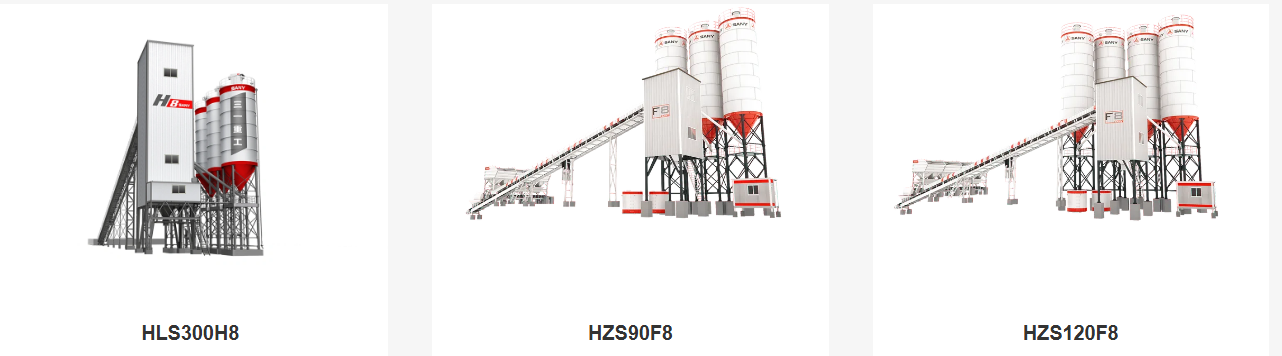
To assess a batching plant's true operating lifespan, mechanical engineers look beneath the cosmetic branding to analyze structural steel grades, welding automation, and core component sourcing matrices. Sany plants, specifically the high-throughput HZS90 (90 m³/h), HZS120 (120 m³/h), and HZS180 (180 m³/h) stationary lines, display high structural optimization metrics.
1. Mixing System: Twin-Shaft Compulsory Technology
Sany utilizes proprietary compulsory twin-shaft mixers across their mainstream stationary configurations, alongside specialized planetary vectors for distinct precast operations.
- Liner Plates & Mixing Paddles: Sany standardizes on High-Chromium Cast Iron Alloy (Cr26) for all internal wear parts, yielding a specialized hardness profile exceeding 60 HRC (Rockwell Hardness Scale). Under standard aggregate loads (limestone/river gravel), this metallurgic grade ensures an operating lifespan of approximately 50,000 to 70,000 batches before replacement thresholds are breached.
- Main Shaft Seal System: Shaft leakage is the primary mechanical failure point in ready-mix production. Sany implements a multi-stage floating labyrinth seal layout integrated with a centralized automatic grease lubrication pump. This pneumatic/hydraulic system maintains continuous backpressure (typically 4 to 6 bar) during active mixing cycles to completely isolate fine cement slurry ingress from the shaft bearings.
2. Structural Steel Work & Corrosion Protections
Unlike localized unbranded steel mills, Sany fabricates its main mixing towers, aggregate storage bins, and skip hoist pathways using heavy-duty certified structural carbon steel (Q235B and Q345B).
- Welding Quality: Main structural columns undergo fully automated robotic submerged arc welding (SAW) procedures, ensuring complete penetration welds that eliminate internal structural fatigue points under high vibration cycles.
- Surface Treatment: The structural framework is treated via automatic shot-blasting to a Sa 2.5 standard of cleanliness, followed by a double-layer polyurethane topcoat. This corrosion protection metric is vital for geo-targeted sites in tropical regions (e.g., coastal Philippines, Indonesia) experiencing continuous marine humidity.
Industrial Automation & Software Control Limits
A concrete batching plant’s structural integrity must be synchronized with reliable electronic telemetry. Sany's automation suite relies on a decentralized dual-computer synchronization framework powered by industrial PLC (Programmable Logic Controller) hardware.
[ Dual Load Cell Scales ] ──> [ High-Speed A/D Module ] ──> [ Industrial PLC Core ]
│
▼
[ Cloud Diagnostics Server ] <── [ Synchronization Bridge ] <── [ Dual PC Interface ]
1. Weighing Precision & Sensor Calibration
Sany integrates high-precision, hermetically sealed load cells (frequently utilizing international component lineages like METTLER TOLEDO or proprietary industrial sensors) with advanced dynamic filtering algorithms.
- Aggregate Scales: Weighing precision is maintained within ±2% variance thresholds.
- Cement, Water, and Liquid Admixture Scales: Maintained within ±1% strict tolerances, satisfying stringent international ASTM and EN206 construction standards.
- Dynamic Pulse Compensation: Sany's software integrates a real-world "inflight material" auto-compensation module. If the aggregate gate closes but 15kg of sand is still falling through the air, the PLC reads the A/D converter trajectory at millisecond intervals and automatically adjusts the gate sequence for the next cycle to prevent scaling accumulation drift.
2. Fault Diagnostics & Electrical Safety
The control cabinet is built with a separate high/low voltage isolation layout to safeguard the computing architecture against erratic construction site power lines. Sany utilizes localized Schneider or Siemens circuit breakers and contactors. If a pneumatic solenoid valve blocks or an aggregate conveyor belt misaligns, the localized PLC immediately triggers a targeted visual diagnostic code on the operator's monitor rather than shutting down the entire plant blindly.
Technical Specifications Comparison Matrix
The data matrix below maps the primary technical engineering boundaries across Sany’s most frequently sourced international stationary and mobile concrete batching line models.
| Technical Parameter | Sany HZS60F (Stationary) | Sany HZS120F (Stationary) | Sany HZYS60 (Mobile Line) |
|---|---|---|---|
| Nominal Throughput | 60 m³/h | 120 m³/h | 60 m³/h |
| Mixer Model / Output | SY1000 Twin-Shaft (1.0 m³) | SY2000 Twin-Shaft (2.0 m³) | SY1000 Twin-Shaft (1.0 m³) |
| Max Aggregate Size | ≤ 80 mm | ≤ 80 mm | ≤ 60 mm |
| Total Installed Power | ~110 kW | ~210 kW | ~95 kW |
| Discharge Height | 3.8 / 4.0 Meters | 4.1 / 4.2 Meters | 3.8 Meters |
| Aggregate Feeding System | Skip Hoist / Bucket Elevator | Heavy-Duty Inclined Belt | Integrated Belt / Compact |
| Foundation Requirement | Standard C30 Concrete Pads | Heavy Reinforcement Grid | Minimalist Steel Frame Pad |
Engineering Evaluation Matrix: Pros vs. Cons
To maintain independent credibility for global procurement managers, Sany plants must be evaluated via a clear-cut balance of advantages and drawbacks.
👍 The Engineering Advantages (Pros)
- High Volumetric Efficiency: Sany plants consistently hit 92% to 95% of their maximum theoretical nominal throughput under continuous 10-hour duty cycles, assuming optimized material supply logistics.
- Advanced Control Redundancy: The dual-computer backup configuration guarantees that if the primary operating terminal crashes mid-batch, the secondary industrial computer instantly takes over the active PLC batching cycle without ruining the batch mix inside the drum.
- Superior Resale Liquidity: Due to Sany’s global brand recognition, these plants retain high residual asset values. A used Sany plant can be resold in global secondhand heavy equipment markets far easier than generic Chinese machinery brands.
👎 The Engineering Limitations (Cons)
- Higher Initial CAPEX Premiums: Sany plants command a 25% to 40% price premium compared to standard localized manufacturing clusters in Shandong or Henan provinces.
- Proprietary Software Barriers: Certain deep automation recalibrations and electronic software overrides require specialized remote access codes from Sany field service engineers, which can cause logistical bottlenecks on remote project sites far from factory service centers.
- Strict Spare Parts Matching: While standard components like pneumatic cylinders or bearing blocks can be sourced locally, specific mixer wear liners and dynamic seal components must be ordered directly through Sany’s supply network to maintain structural tolerances.
Procurement & Global Sourcing Siting Advice
When sourcing a Sany batching plant for your infrastructure project, procurement managers must evaluate several operational trade-offs:
- Feeding System Selection: For congested urban job sites or factories with tight footprints, choose the HZS60 Skip Hoist configuration. For heavy commercial ready-mix plants requiring non-stop daily output exceeding 800 cubic meters, bypass skip systems entirely and source the HZS120 Inclined Belt Feeding line to eliminate mechanical rope-wear limits.
- Power Grid Compatibility: Standard Chinese factory plants are wired for 380V/50Hz/3Phase. Ensure your sourcing purchase order explicitly defines your target country’s power grid metrics (e.g., 440V/60Hz for certain regions in the Philippines or Saudi Arabia) to prevent electric motor burnouts during the initial commissioning phase.
- Logistical Lead Times: Standard Sany configurations have an average factory lead time of 30 to 45 days, while complex custom dual-mixer setups can exceed 60 days. Ensure your local site's civil work foundation engineering is poured, cured, and ready for anchor bolt setting at least 21 days prior to the cargo arrival at your target port of entry.